


Most people who come to us have already done the maths on subscription software. They have a POS quote in front of them, a per-outlet price, and a growing suspicion that in three years they will have paid for the thing twice over and still own nothing.
That suspicion is correct. But there is a second question hiding behind it, and it is the more interesting one: if restaurants are willing to pay a monthly fee for this software, why are you paying it instead of collecting it?
The two ways to buy restaurant software
Every restaurant platform on the market is sold one of two ways, and the difference decides what you are left holding in five years.
Renting it (SaaS)
You pay monthly, per outlet. The vendor hosts it, maintains it, and keeps the code. This is Toast, Petpooja, PosBytz, Blink and most of the market. It is genuinely convenient: somebody else handles uptime, backups and updates.
The costs are less obvious. Your price is set by someone else and can change. Your customer data sits on their servers. When you need a feature, you file a request and wait. And the money leaves every month, forever, converting into nothing you can sell or borrow against.
Owning it (source code)
You pay once and receive the codebase. You host it, brand it, and change it. The vendor has no control over your deployment and no visibility into your customers. The convenience is lower on day one: you need a server, and someone has to deploy it.
What you gain is that the software becomes an asset. It appears on your side of the balance sheet rather than your expenses, and nobody can raise its price.
The part most buyers miss
Here is where the conversation usually turns. Buying source code is normally framed as a way to stop paying a subscription. That framing is too small.
If you own a multi-tenant restaurant platform, you are not just a restaurant that saved money on software. You are a software vendor who has not started selling yet.
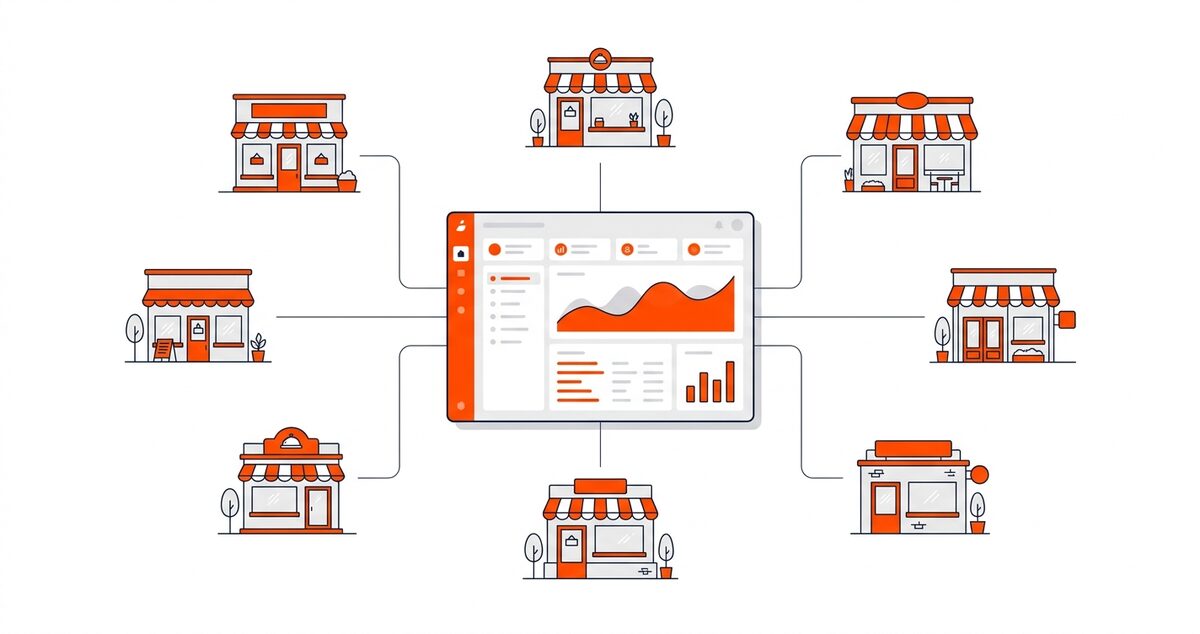
Multi-tenant means one installation serves many restaurants, each with its own subdomain, menu, staff and data, kept completely separate. That is the same architecture Toast and Petpooja run on. If you have it, nothing stops you signing up restaurants other than your own — and charging them monthly.
The economics flip at that point. A subscription you pay is a cost that scales with your growth. A subscription you collect is revenue that scales with your effort.
What you actually need to run a restaurant SaaS
Owning a codebase is not the same as owning a business. These are the pieces that have to exist before you can charge anyone, and the ones people underestimate:
Multi-tenancy that genuinely isolates data
Two restaurants on your platform must never see each other's orders, menus or customers. This is the hardest part to retrofit and the easiest to get wrong. Done properly, each tenant gets its own subdomain and its own scoped database access, and the isolation is enforced at the framework level rather than by remembering to add a where clause to every query.
Subscription plans and billing
You need plans, prices, trials, upgrades, downgrades, failed payment handling and invoices. This is weeks of work that produces no visible feature, which is exactly why it gets postponed — and why so many "white-label" offers quietly leave it out. Check for it before you buy.
Usage limits that enforce themselves
A plan is only a plan if the limits hold. If your Basic tier allows two branches and fifty menu items, the platform has to refuse the third branch, not trust the restaurant to behave. Limits that exist only on the pricing page are decoration.
The operational surface restaurants expect
Restaurants will not switch to your platform because it bills well. They switch because it runs their floor: a POS at the counter, QR ordering at the tables, a kitchen display that keeps the line moving, delivery dispatch, and reports their accountant accepts. Staff need their own logins with the access their role requires and nothing more.
Mobile apps
Waiters and delivery riders do not work at a desk. In practice you need an app for the merchant, one for delivery staff, and one that turns a phone or tablet into a POS terminal. Built in Flutter, one codebase produces both Android and iOS, which halves what you maintain.
What this costs in practice
Building the above from scratch is a year of work for a competent team, and most of that year is spent on multi-tenancy and billing rather than on anything a restaurant will ever see. That is the gap source code fills: you start from a platform that already does these things and spend your time on customers instead.
The honest trade-off is that you take on hosting and maintenance. If you have no technical help at all, a subscription may genuinely suit you better. If you have a developer, or can hire one, owning the platform changes what your business is.
How to evaluate a platform before you buy
Whatever you end up buying, ours or someone else's, these are the questions worth asking. Vague answers to any of them are the answer:
- Do I get the complete source code, or a licence to run a binary? "White label" often means rebranding someone else's hosted product, which is still renting.
- Is it genuinely multi-tenant, or one installation per restaurant? One-per-restaurant does not scale into a SaaS business.
- Is subscription billing already built and working? Ask to see plans, trials and a failed payment being handled.
- Are the mobile apps included as source, or only as published apps? Apps you cannot rebuild are apps you cannot rebrand.
- What is the stack? Ordinary frameworks mean you can hire ordinary developers. Something proprietary means you can only hire the vendor.
- Who holds the data? If customer records live on the vendor's servers, you do not control your own business.
- What happens after launch? Deployment, updates and the cost of custom work should be written down before money changes hands.
Is this right for you?
It is worth being direct about who this does not suit. If you run one restaurant, have no technical help, and want software you never think about, a subscription is a reasonable purchase and you should buy one.
Owning the platform makes sense when at least one of these is true: you run several outlets and the per-outlet fees have become a real number; you want to sell software to other restaurants; you operate somewhere the big vendors serve badly, whether that is payment methods, language or price; or you need the product to work differently from how it ships, and waiting on someone else's roadmap is not acceptable.
If you recognise yourself in that list, the next step is not a sales call. It is looking at a working platform and deciding whether it does what you need.