


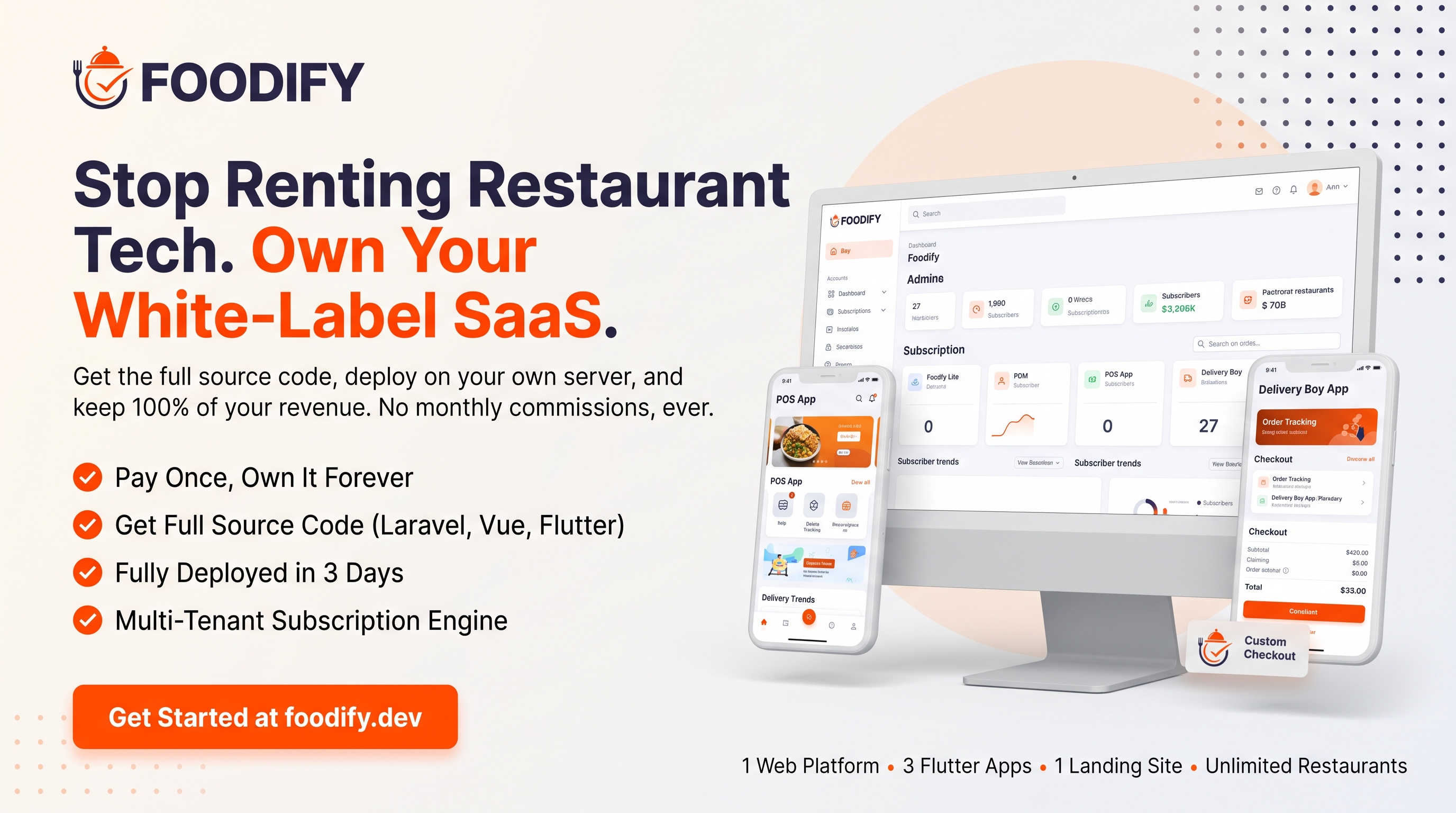
Building a software business in the restaurant industry usually involves a frustrating compromise. You find a great platform, sign up as a reseller or agency partner, and start onboarding local restaurants. But there is a catch: you are paying monthly licensing fees, the vendor takes a percentage of every food order, and you don’t actually own the underlying technology.
If you decide to switch providers, your business vanishes overnight. You are effectively renting your business.
The alternative, building a multi-tenant restaurant platform with mobile apps, subscription management, and payment routing from scratch, takes hundreds of thousands of dollars and months of development.
But what if you could bypass the development phase and simply buy the platform outright? Owning the source code to your white-label restaurant software fundamentally changes the economics of your business. Here is exactly why moving from a subscription reseller model to a pure ownership model is the smartest move for your next SaaS venture.
The Flawed Economics of "Pay Forever" Software
Most restaurant tech vendors structure their partnerships to benefit themselves, not the reseller. When you use platforms like GloriaFood, Orderli, or Blink, you get a solid product, but the vendor ultimately holds the keys.
Under the typical reseller model, you face strict usage limits, essential features locked behind expensive tiers, and mandatory license renewals. Worse, many vendors take a cut of your clients' transactions. This means as your clients grow and process more orders, your overhead increases right alongside them. You are penalized for your own success.
When you own the platform, meaning you purchase the full source code and deploy it on your own servers, those limitations disappear. You pay once. You never pay a commission on subscriptions, food orders, or merchant payouts. Whether you sign five local cafes or an enterprise chain with 500 locations, 100% of the revenue stays in your bank account.
What a Complete Multi-Tenant Ecosystem Actually Looks Like
Launching a successful restaurant SaaS requires much more than just a digital menu. Restaurants expect a unified ecosystem that handles front-of-house operations, back-of-house management, and delivery logistics.
When evaluating a white-label solution like Foodify, you aren't just getting a website. You acquire five interconnected products running from a single codebase:
• The Master Web Platform: This includes the master admin panel for your SaaS, individual restaurant dashboards, QR table ordering, a Kitchen Display System (KDS), and robust reporting modules.
• Native POS App: Built with Flutter, allowing staff to punch in orders and process payments on site.
• Merchant App: A dedicated management tool for restaurant owners to track daily operations on the go.
• Delivery Rider App: An automated logistics app to route web orders directly from the KDS to your delivery drivers.
• A Pre-Built Landing Site: A fully designed Nuxt frontend where prospective restaurants can view your pricing plans and self-register.
Because the system is built on modern, developer-friendly frameworks, Laravel 12, Vue 3, and Flutter, there is no proprietary technology to learn. Any competent development team can take the source code, apply your branding, and extend the features as your market demands.
One Codebase for Every Food Business Model
A major challenge in software sales is finding a product versatile enough to serve different types of businesses. A system built exclusively for fine dining won't work for a fast-paced cloud kitchen.
A true multi-tenant architecture solves this by allowing you to configure the software based on the specific client. For single cafes, you can deploy simple QR digital menus and an online ordering storefront. For multi-branch chains, the software allows a single owner dashboard to manage distinct menus, inventory, and staff permissions across different locations.
The system also natively supports food courts and cloud kitchens, where web orders flow directly to the kitchen display and out to the native delivery app without requiring the customer to download anything.
Engineered for the Global Market
If you are launching restaurant software outside of the US or Western Europe, you’ve likely noticed that most platforms ignore your operational realities. They lack support for local payment gateways, struggle with complex tax configurations, and often break when attempting to display right-to-left (RTL) languages.
A globally viable white label platform must be built with localization at its core. For example, the Foodify interface ships natively in English, Arabic, Bengali, and German, with full RTL support for Arabic markets. Adding an entirely new language requires only a simple update to a translation file, not a core code change.
Financial routing is equally adaptable. Currencies, tax rules, delivery charges, and time zones can be configured individually per restaurant. With integrated fintech covering Stripe, PayPal, Flutterwave, SSLCommerz, and cash on delivery, you can process payments across North America, the MENA region, and South Asia right out of the box.
How to Go Live in 3 Days
The distance between purchasing source code and actually running a live software business is usually measured in months. Server configurations, domain routing, SSL setups, and payment integration can stall a launch indefinitely.
To eliminate this friction, look for a platform that includes deployment in the purchase price. Once you secure the license and provide your server and domain details, the deployment team handles the installation, applies your branding, and connects your Stripe or payment gateways. Within 72 hours, you have a live, fully branded SaaS platform ready to onboard its first paying restaurant.
By stepping away from the endless monthly fees of the reseller model and choosing true ownership, you build equity in your own brand. You control the data, you set the rules, and you keep the profits.
Ready to evaluate our transparent pricing plans and compare our ownership model? Test drive the full admin panel and POS today at [Insert Link to foodify.dev here].
Frequently Asked Questions (FAQ)
Can I run multiple distinct restaurants on this platform?
Yes. The software features true multi-tenancy. Every restaurant you onboard gets its own secure subdomain, digital menu, staff portal, and database segment. You can set branch limits and enforce feature restrictions based on the subscription plan you assign them.
Do I need an advanced development team to manage this?
No. While you get the full source code (Laravel, Vue, Flutter), the platform is designed to be fully operational upon deployment. You only need a developer if you wish to build custom features or integrate highly specific local APIs that aren't already included.
How does the billing work for my restaurant clients?
The platform features a built-in subscription engine integrated with Stripe. You can create custom pricing tiers, offer free trials, and automatically bill your clients repeatedly. The payments go directly to your configured gateway.
Who owns the data generated by the restaurants?
Because the platform is deployed entirely on your own servers, you have 100% data ownership and privacy. Nothing is routed back to a central vendor, ensuring you maintain complete control over your customers' information.